This girl is brilliant. Seriously.
I'm in complete awe of people who can cram an entire book into a three-minute pop song. And Kacey Musgraves does that beautifully here.
As a single girl in the Ozarks, I also have to say I relate to this one on a personal level. I adore my area of the country, but I'd be lying if I said that certain area events (remember Sarah Ockler?) and attitudes didn't just embarrass me down to my toes.
...How about you? What songs have you sworn told your own story?
Showing posts with label Life's Chapters. Show all posts
Showing posts with label Life's Chapters. Show all posts
Monday, December 10, 2012

Saturday, September 1, 2012
FRINGES
Brainstorming topics for this month’s theme at my YA group author blog (characters on the fringes), I instantly thought of a recent clip from CBS This Morning. In talking about her latest release, WHERE WE BELONG, Emily Giffin mentions returning to her journals to get in the right mindset to write a younger, teenaged character.
The results? She was shocked; her teen years were happy and stable, but as she says in the video below, her journals were still filled with angst:
Which makes me wonder—has there ever been a teen who hasn’t felt on the fringes for one reason or another? Don’t we all, as our own toughest critics, lug around our own lot of insecurities?
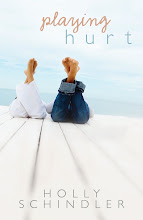
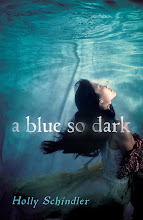
The MCs from both of my own published books are also definitely characters who feel on the fringes; in A BLUE SO DRAK, Aura feels outside the boundaries of “normal” life as she cares for her schizophrenic mother. In PLAYING HURT, Chelsea’s accident ends her basketball career, making her suddenly feel on the fringes with her former teammates.
Sure, there’s angst in my books, to use Giffin’s word. But there’s also, I’d argue, a sense of acceptance by the end of both novels. In BLUE, Aura is learning to accept both her family’s history of madness and her own creative impulses. In PLAYING HURT, Chelsea is finally accepting the end of her own playing days, while looking forward to a life returning to the game she loved in another capacity—her new dream, by the novel’s close, is to become a sports psychologist.
Maybe that’s a big part of moving from adolescence to adulthood: acceptance of oneself. Mistakes, flaws, warts and all. It’s being able to sing off-key in traffic and not caring that the windows are down. It’s finding a sense of humor about oneself. It’s that perspective Giffin mentions—it’s knowing I’m not perfect, but neither is everyone else. It’s knowing in some way or another, we’re all on the fringes.
The results? She was shocked; her teen years were happy and stable, but as she says in the video below, her journals were still filled with angst:
Which makes me wonder—has there ever been a teen who hasn’t felt on the fringes for one reason or another? Don’t we all, as our own toughest critics, lug around our own lot of insecurities?
The MCs from both of my own published books are also definitely characters who feel on the fringes; in A BLUE SO DRAK, Aura feels outside the boundaries of “normal” life as she cares for her schizophrenic mother. In PLAYING HURT, Chelsea’s accident ends her basketball career, making her suddenly feel on the fringes with her former teammates.
Sure, there’s angst in my books, to use Giffin’s word. But there’s also, I’d argue, a sense of acceptance by the end of both novels. In BLUE, Aura is learning to accept both her family’s history of madness and her own creative impulses. In PLAYING HURT, Chelsea is finally accepting the end of her own playing days, while looking forward to a life returning to the game she loved in another capacity—her new dream, by the novel’s close, is to become a sports psychologist.
Maybe that’s a big part of moving from adolescence to adulthood: acceptance of oneself. Mistakes, flaws, warts and all. It’s being able to sing off-key in traffic and not caring that the windows are down. It’s finding a sense of humor about oneself. It’s that perspective Giffin mentions—it’s knowing I’m not perfect, but neither is everyone else. It’s knowing in some way or another, we’re all on the fringes.
Friday, June 22, 2012
MILES TRAVELED

This summer, the journey I’m taking doesn’t really have to
do much with packed bags and playing Punch Buggy in a backseat. Instead, this summer, I’ve been doing some
genealogical research, tracing the miles my ancestors traveled.
It’s been fascinating, actually—I’m amazed at how much you
can learn about a life simply by solidifying two or three major dates (usually
birth, marriage, and death, or, as one genealogist recently phrased it as we
chatted, “hatched, matched, and dispatched”).
I’m especially intrigued by the women; right now, I’m trying
desperately to trace my matriarchal line, straight through my
grandmothers. I’ve made it back to my
great, great, great, great grandmother, who was born in the late 1700s. This is where the trail gets foggy (I’ve yet
to figure out her mother’s name). I do
know, though, that this is the ancestor who officially brought my family to the
Midwest; I’ve discovered that while my roots are thick here in Missouri (I’ve
got a line, through my maternal grandfather, that runs six-generations deep in
Southwest Missouri), I’ve also got equally thick roots in Tennessee, thanks to
that four-times great grandmother (I’m pretty sure I’m related to the entire county of Putnam).
I wish I could get all those women on the family tree in a
room, wish I could listen to them tell their own stories. I’d love to hear
just how they felt, what they went through in-between being hatched and
dispatched. I’d love to get the truth:
love to hear all about those miles they physically
traveled in their own lives.
But the more I dig, the more blanks my what-if brain wants
to fill in. And it seems that those are
miles, too—miles you travel in your own mind, thanks to your imagination…
Tuesday, May 1, 2012
HEATED CONVERSATIONS WITH WATER FOUNTAINS
Throughout May, we're celebrating mothers (and parental figures in general) at both of my group author blogs: YA Outside the Lines and Smack Dab in the Middle...So, in honor of all things Mother’s Day, I’ve decided to share the mother of all plans. Yes, oh, yes, I had it all worked out. I was twelve, and it was the summer before
junior high, and this was it—this was going to be the moment in which I won Mom
over, got her to see things from my (admittedly, completely blurry) point of
view.
First, a bit of backstory:
I was nine years old when the worst, most tragic event of
all time came crashing down upon my slender little third-grader shoulders.
I could no longer read the chalkboard.
It happened suddenly, actually—I came back from spring break
to find that my desk had been moved by well-meaning floor-sweeping janitors
from the front row to the back. And the
daily handwriting assignment, which our teacher put up on the board for us to
copy each morning, was a complete and total blur. I couldn’t see. Period.
My first glasses were fairly strong (for 20/200
vision). And—I hated them. Talking hate here. Hate. The fact that it was 1986 didn’t help,
either. Remember glasses of the
‘80’s? The enormity! The hideousness! Uuuugh!
And it officially began: the battle with my mom for
contacts.
I didn’t just want contacts.
I lusted after them, especially as my eyes grew progressively
worse. By the time I was headed for
junior high, my prescription was creeping up toward a -5.00 (20/500 vision),
and there was no way I could just take my glasses off at that point and navigate
the majority of my days without them, haul them out of a backpack pocket to
read the board once I got to class. Not
if I didn’t want to start having long, heated conversations with hallway water
fountains, anyway.
So, the summer before seventh grade, I came up with my
infinitely brilliant plan: I would get
the ugliest pair of 1980’s glasses I
could find. I mean, ugly. Proof:

I just knew what would happen: when we picked up the
glasses, and Mom saw how awful I looked, her eyes would widen in sheer
horror. She’d insist we exchange the
glasses for contacts, immediately, if
not sooner.
Yeah. Didn’t
work. As my seventh grade picture up
there reveals.

Sure, I did get my contacts—the summer before high school, actually. And I wore them until I gleefully pitched the
lenses and all the unending vials of cleaning solution in the trash shortly
after my thirtieth birthday. In the end,
the things that are important to us as teens are never the things that are important
to us as adults. This Mother’s Day, as
my own mom and I laugh at this—and other—horribly failed grand schemes, I’ll
also be remembering that my teen characters should always have plans of their
own that are obviously doomed, that provide a bit of comic relief, and that
show them stumbling and learning and laughing all along their life’s
journey.
Sunday, April 22, 2012
HE-WHOS AND INTERNAL GRATIFICATION
Shortly after inking my very first book deal, I began to meet them: the dreaded He-Whos (enter demonic, minor-sounding organ chords here).
Yes, the He-Whos. What, exactly, is a He-Who, you might ask? Not to be confused with a yahoo or a nincompoop (although, according to some sources, the definitions overlap somewhat), a He-Who is a very sneaky creature whose natural habitat is a would-be author’s personal life. In most cases, said He-Who has been in a struggling author’s life for quite some time—years, some of them—playing the role of Supportive Confidant. Upon the announcement of an author’s long-awaited book deal, the face of said Supportive Confidant melts into a giant fiery pile of slime, exposing the dreaded, nasty, much-feared He-Who underneath.
A He-Who takes many different forms. The He-Whos I’ve encountered fall into three basic categories:
1). He who shows some initial interest when you announce your book sale, but when you disclose that it’s a YA or MG, he raises his lip off his teeth, lets out an, “Ew,” and explains, “I only read high-quality, serious works of literature. I do not read children’s books.” This statement is expressed rather emphatically, while rolling the “r”s, puffing on an antique scrimshaw pipe, and gesturing wildly to flash the professorly suede elbow patches on his coat. (This He-Who also has the same reaction to any other subcategory of genre fiction: romance, sci-fi, mystery, etc.)
2). He who does not have any interest in your book, but—OMG! He just happens to have a manuscript himself! And it’s awesome! And you should read it—and while you’re at it, rewrite it! And then give it to your publisher! Wouldn’t that rock???
3). He who is just so busy, he does not have the time to read your book—even though the book was released three years ago, and this particular He-Who has also watched every single episode of MY BIG REDNECK WEDDING, sends you emails with links to “hilarious” YouTube vids three times a day, and has repeatedly called to inform you that he has discovered the best way to mow a lawn: with manicure scissors.
Okay, all right, so I’m being a bit flip in my descriptions…But honestly, these people really do exist. These reactions—or some version of them, anyway—really do happen. I can’t say I understand it, two years after my first book hit the shelves, two years after the He-Whos started showing their faces. I might even think I was alone in the whole He-Who thing, had I not run into articles online and in print in which authors described similar experiences. Knowing this is an unfortunate part of the gig, I slowly began to develop a methodology for dealing:
Treat He-Whos the same way you treated early rejections. Okay, so a personal rejection stings worse than a professional one. But the point is, you didn’t let one professional “no”—or, if you’re like me, more than a thousand professional “no”s—derail you. You screamed at times, you shed a few tears, but then you put it away and you went back to work. You didn’t dwell on one response. You also didn’t let it convince you that your pursuits weren’t worthwhile. You didn’t let it convince you that everyone would have the same reaction to your work. You didn’t stop trying, and you didn’t stop sharing. And, most importantly, you didn’t let a few—or hundreds—of rejections dim your own internal gratification. Not the internal gratification you felt for having created a novel you loved. You were proud of yourself then, regardless of the final external response from an editor or agent. You maintained your own internal gratification while letting those rejections push you increasingly closer to your first “yes.”
There’s no predicting how people will react to anything—as authors, we spend so much time with complete control over our characters and our internal worlds, it’s a surprise when our external worlds don’t quite behave like we’d expected or hoped. But the great part is, though, that not everyone is a He-Who. And just as your rejections pushed you closer to finding the right “home” for your work, always allow the He-Whos to push you closer to those who are supportive, are truly happy for you, every step of the way. In my case, unending support and cheering wound up filtering into my life from all sorts of different corners. It came from my mom and brother, who had supported me all along the journey, and it came from some (now infinitely appreciated) old friends, from fellow authors, fantastic local librarians, from bloggers and reviewers—and eventually fans! It even came from some unexpected sources (like old classmates who sent messages through my website to congratulate me).
The ability to maintain your internal gratification is one of the most important skills for any author to master. That internal gratification—that self-pride—will get you through most anything, in your writing career. It will get you through any of the inevitable low points: rejections or less-than-glowing reviews or lower-than-expected sales numbers, etc. That internal gratification will often be your lifeblood, as an author, and is far too precious to ever, ever be handed off to some old He-Who.
Sunday, April 1, 2012
SPRING & MY ROOM

Virginia Woolf once famously insisted that in order to write fiction, a woman needed money and a room of her own.
Eleven years ago this May, that’s exactly what I got: a room of my own.
I’d just completed my master’s, and in the midst of all my fellow classmates making plans to move on to PhD programs or interviewing for full-time employment, I was taking my mom up on her offer. “Let me feed you,” she said, “and you can write.” It was the only thing I’d ever wanted to do, after all—and there was no way I was going to pass up such an incredible opportunity.
A couple cans of paint and a new desk later, I had it—my own office, in the former guest bedroom of my childhood home. It wasn’t incredibly high-tech, in the beginning: I had a dinosaur of a computer, so old it didn’t even have a modem. And I had a phone, and a MailStation where I could send emails (no attachments). And a coffee maker. And that pretty much did it for the electronics.
But what I did have was time. All the time I needed. And that turned out to be a good thing, indeed…
I’d banked on two years. Two years tops to get started. Two years came and went. So did three. And four. Five.
Each spring, as my alma mater’s graduation day made the local news, I’d wind up taking stock of how far I’d come: I’d look back on the year’s submissions. I’d remind myself of all the new work I’d written. I’d show myself the list of books (either partials or complete manuscripts) currently being considered by publishing houses or agents.
Six springs went by. Seven.
Finally, finally, finally, on that eighth spring after my graduation, I had a book in development. A book in development! That eighth spring, as I tuned into the news and watched flashes of MSU’s commencement, I thought about that twenty-four-year-old who’d just gotten her master’s, who’d just written a creative thesis, who’d published a few shorter pieces and was convinced that writing and publishing a novel would be a breeze. I thought about how much she had to grow as a writer before selling her first book.
The thing is, if I hadn’t had the ability to devote full-time, seven-day-a-week attention to my writing, I know it would have taken twenty years or more to get that first acceptance…if ever. (That “if ever” are the two scariest words in the English language…) I had so far to go, and so much to learn…I just don’t think I ever would have gotten there without that room of my own, and the freedom from financial concerns.
This spring—and every spring hereafter—with multiple books on store shelves, I know I’ll take more than just a few moments to be grateful for the most incredible gift I’ve ever (and without a doubt, will ever) receive: the simple gift of time.
Thursday, February 2, 2012
GETTING IN MY CHARACTERS' HEADS
This is one of my mom’s favorite pictures of me and my brother:

The background: I loved that dress. I mean—love. It was the first long dress I’d ever had, and I felt so grown-up and beautiful. I just had to get Mom to take my picture (with our ultra-high-tech Polaroid)…and my brother, unable to let such a perfect gonna-get-her-now opportunity just slip him by, protested. He wanted in the picture, too.
“Oh, just let him in,” Mom said. At which point, he raced to his room and got the ugliest hat he could. Mucking up my oh-so-beautiful moment with a ratty old red stocking cap.
Sure, we’re wearing smiles in the pic. But before the Polaroid could even develop the picture, I’m pretty sure the boy got pummeled.
Such is life with a sibling.
I’ve never written a novel based on anything that happened to me—never based any of my characters on any person I’ve ever met. (I have no personal experience with mental illness, as does the protagonist of A BLUE SO DARK, and I’m no athlete, as are the main characters of PLAYING HURT.)Still, tough—bits of yourself just naturally leak out when you’re writing fiction—your humor, observations, beliefs, they all sneak into every character you do build. (Which, I think, is often why a novel feels so personal to a writer. I really think that letting someone read your book allows that person the kind of access into your head that they’d never have, through just day-to-day, face-to-face interactions.)
All those relationships in life—family or friends—allow us to experience the range of human emotions. I’ve never directly based any of my characters’ relationships on any relationship I’ve ever had in life, either. But I’ve been there—through those exciting meetings, through losses and disappointments, through love and anger and sweet moments of forgiveness. And when I needed to describe the relationship between Chelsea and her younger brother Brandon in PLAYING HURT, I thought back on instances like the ratty red hat. Having been there before means that I can really get into each of my character’s heads as I write a book, and describe what they’re feeling throughout the pages of my novels.
Monday, January 23, 2012
THE SCARIEST FIRST EVER (WHY I ALSO WRITE MG)
While many of the firsts in my own life carried with them a swirl of different emotions—excitement and joy and uncertainty and confusion and elation—one first has the power, even as I think back on it today, to bring back only one emotion: pure, 100% terror.
The first day of junior high.
Sure, it can sound a little goofy, now, to call it one of my all-time most frightening experiences. And, to be fair, I certainly faced firsts, as I grew older, during which I had more to risk, had more at stake, than I did facing my first day of junior high. But I’ve never been quite as frightened by anything. Never.
In some respects, I shouldn’t have been scared at all—my junior high was actually an extension of my elementary school. I was going to the same building where I’d been a student for seven years by the time I started junior high. But…my closest friend had moved away the summer before; we’d been friends since the second grade, and of course I felt a bit lost going into junior high without her. I was also just incredibly shy, and my heart would race at the mere idea of being in the midst of so many new faces, strangers, in such a new environment—sure, the building was the same, but lockers? Fighting hallway traffic every hour? Changing clothes for PE? It was all uncharted territory.
Gonna Party Like It's 1987:
Far right: me (in the penguin T-shirt) and my closest elementary-school friend (in the pink shorts) at my brother's birthday party.
Thinking back on it, I can still feel the nervous sweat breaking out and my legs going weak as I rounded the corner to East Hall that first morning, toward the science classes (my first class was biology). I remember what I was wearing (purple shirt, vest, shorts), and how I literally thought I would faint before I got to that classroom.
Long story short, I made it. No fainting. I even made it through lunch.
Surviving junior high is just one example of a first that makes me certain, as an adult, that I’ll figure my way out of tough or scary situations. Back when I was twelve, though, I didn’t have that certainty. I hadn’t maneuvered on my own enough to know that I could trust myself. And that’s what made that first day so frightening.
It takes serious guts to be the kids we write for. Because every single day, one of them is facing some first that terrifies them the same way the first day of junior high terrified me. And they don’t have enough triumphs in their lives yet to know for sure they’ll figure their way out. They’re just taking the plunge…
I so admire those kids. And that's a big part of the reason why, in addition to YA, I also write for the MG crowd. And I just feel so privileged to be writing for such an incredibly brave bunch.
Sunday, November 15, 2009
PICTURE THIS...

So I’m putting together our yearly calendar...for 2010, I'm using pictures of me and my brother, John, when we were little. This particular black-and-white is my shot for June…I’m thinkin’ it was taken by our next-door neighbor the summer before my first-grade year.
…Makes my ears fill with a Cyndi Lauper soundtrack just looking at it. Right about this time, I was obsessed with She's So Unusual (the first record I ever bought). Later that year, I even dressed up as Cyndi Lauper for Halloween!
I think I'll reclaim "Girls Just Want To Have Fun" as my personal anthem...
Tuesday, September 8, 2009
MILES TRAVELED
So I’m getting rid of the car I’ve had since college…cleaning it out was like an episode of This Is Your Life.
Sedimentary layers in the glove compartment and under the front seats contained ancient parking permits, faded receipts, a long-forgotten villanelle written for a poetry course, and a couple of notes from old friends: “Hey—I’m home from work. Come on over.” (Remember the pre-cell phone days when you stuck notes under windshield wipers??) Not to mention broken guitar picks, squeaky dog toys, hand-knitted winter hats, and paperbacks I read at lakeshores…and even a few scraps of paper I used to plot out my earliest attempts at novels, right out of grad school.

It’s just stuff—but really, it’s also the triumph of graduation, the heartbreak of friends that scatter like dandelion seeds, the thrill of new creative ideas that have to hit paper before the front wheels hit the driveway on my return home…
In a way, it really does feel like one of life’s chapters has come to an end…but it also feels like I’m standing right smack in the middle of the first paragraph of a new chapter...like I’m a little girl reading past her bedtime, hunkered down under the covers with a flashlight, anxious to find out what happens next.
Sedimentary layers in the glove compartment and under the front seats contained ancient parking permits, faded receipts, a long-forgotten villanelle written for a poetry course, and a couple of notes from old friends: “Hey—I’m home from work. Come on over.” (Remember the pre-cell phone days when you stuck notes under windshield wipers??) Not to mention broken guitar picks, squeaky dog toys, hand-knitted winter hats, and paperbacks I read at lakeshores…and even a few scraps of paper I used to plot out my earliest attempts at novels, right out of grad school.

It’s just stuff—but really, it’s also the triumph of graduation, the heartbreak of friends that scatter like dandelion seeds, the thrill of new creative ideas that have to hit paper before the front wheels hit the driveway on my return home…
In a way, it really does feel like one of life’s chapters has come to an end…but it also feels like I’m standing right smack in the middle of the first paragraph of a new chapter...like I’m a little girl reading past her bedtime, hunkered down under the covers with a flashlight, anxious to find out what happens next.
Subscribe to:
Posts (Atom)