Now, this is the kind of author-reader interaction I just adore...My neighbor, Alex, is an aspiring author. So when her class began work on a job shadowing program, she came over to talk about what it takes to be a full-time writer. And the discussion was just a delight.
Sure, signings and readings are a ton of fun, but in those scenarios, I don't get much of a chance to really interact with my readers. At a signing, we say hello, I scrawl my name, and the reader waves goodbye. But with an interaction like this, I get a real chance to touch base...I've said it before, but that's a big part of the reason why I really can't get enough of the blogosphere. Through social networking, etc., I get a chance to develop ongoing relationships with readers; for me, those relationships are absolutely priceless.
...The vid's a bit longer than most I've posted, but Alex just asked such great questions, and I had such a great time, I couldn't bear to cut out another second of footage...Check it out, as we discuss how long it takes to actually get started, and what a joy it is to stick with a dream through the hardships, long enough to see the dream start to come to fruition:
Showing posts with label YA On YA. Show all posts
Showing posts with label YA On YA. Show all posts
Friday, February 3, 2012

Wednesday, June 1, 2011
CONVERSATION WITH A BALL PLAYER
Okay, so it's more than well documented at this point that though I've written about ball players, I'm definitely not an athlete myself.
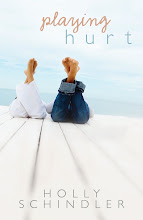
Imagine my thrill, then, when a ball player signed up for the PLAYING HURT Blog Tour! Yes—a book nut and an athlete, all rolled into one! I was absolutely delighted to get a chance to interact with Caitlin at Scarrlet Reader, to discuss PLAYING HURT and athletics in YA literature.

HS: Hi, Caitlin! Can you tell us a bit about yourself—and your sports history?
C: Hey Holly! Thanks so much for having me here. Now, a bit about myself? Well, I’m a 15 (almost 16!) year old sophomore in high school. I’m a very active and competitive person and I have a great love for reading. My sports history goes all the way back to when I was about 6 years old when I started playing soccer, but now a day, I’m a strictly softball only player. It really is a passion of mine. I’ve played from my town recreation team for seven years to a tournament 16U travel team. While reading Playing Hurt, I was wondering if it was a love of playing a sport that helped inspired the book.
HS: Oh, if you only knew…I’m really, really not an athlete. I’m a bit of a klutz, actually. (I swear I can fall around corners!) I’m really flattered, though, that the depiction of sports felt authentic enough to you that you wondered if I played / loved sports.
I definitely have a much stronger appreciation of athletics now that I’m older—I realize now just how mental sports are. I can’t imagine what it must be like trying to come back to the game after an injury—or even after surgery, as is often the case with athletes who have overused their bodies.
I believe you’ve had some experience with a sports-related injury yourself. Can you tell us about that?
C: Well, I’d first like to thank God that I have never had as severe injury like Chelsea (*knocks on wood*), but I have definitely had my fair share of sports injury in my years. One of my most serious injuries from over the years happened when I was pitching for softball. It was just a regular game while I was pitching. A girl comes up to hit, I pitched the ball, and it all happened really fast. The ball had hit off the bat and came straight back at me, towards my face. I had enough reflexes to try and bring my mitt up to block the ball, but I was only able to reflect it a bit and it hit me on the side of my face right next to my left eye. I remember hearing the gasp from the people in the stands and the pain on the side of my face. I was kind of in shock and just fell to a knee. My coach ran out and they took me off the field. I was examined and ice packed. I honestly just like to shake these kinds of things off but people love to make a bigger situation out of things then needed and they didn’t let me play for the rest of the game. I ended up coming out of it with minor scars, but I did have a giant, nasty purple bruise on my face for two week (not fun, lots of cover up).
It just shows how easily you can be hurt and how suddenly. I’ve had teammates with broken legs, strained wrist and angles, and even a few knocked out teeth and, it’s scary thinking about all the possibilities of injuries that could happen. I’ve been hit by pitches (once really bad in the head, but thank Lord for helmets), ground balls, aching shoulders from pitching too much. I’m use to those pains, but a permanent pain like with Chelsea’s hip is something that I’m not sure I could deal with. Which leads me into asking – Why was it a hip injury you chose to have happen to Chelsea? I know with basketball players sprained ankles or wrist would be pretty severe too, so a hip injury was something I wasn’t expecting.
HS: First of all, I’m so sorry to hear of your accident. Though I’m a bit of a klutz, I’ve never broken a bone…I can’t imagine how much your injury must have hurt…
When I came up with the sports subplot (which didn’t come about until the very last rewrite…about five years after I wrote the first draft!), I immediately imagined Chelsea as a workaholic. Somebody who lived basketball—who felt guilty when she wasn’t working out, or practicing, or engaged in visualization techniques…
I also knew I wanted to show the scene of Chelsea’s accident, and wanted a dramatic impact—I tried to picture scenarios of Chelsea falling, and what it might look like from the stands—or from the screen of Chelsea’s bedroom TV, as she watched the DVD of her last game over and over…
Of all the scenarios I imagined, none seemed quite as dramatic as Chelsea coming down from a jump, into the splits—and breaking her already-stress-fractured hip.
What kind of impact has being injured had on your ability to play? Do you find yourself hesitant now in a way you weren’t before? What’s the mental healing process been like?
C: Well, being physically hurt, believe it or not, causes me more mental pain then being in actual physical pain sometimes. There have been times where my shoulders are killing me or my elbow feels like it’s got to burst, but I never like to let it on so it’s always a mental battle with myself to push past the annoying pains. There have been times where injuries have affected my playing, like when I sometimes twist my ankle the wrong way and can’t run as fast as I want or my shoulder starts to hurt and I can’t pitch as consistently, but I would say I have never been hesitant towards going right back into it (unless for some reason I’m really nervous about playing a certain team!)
Though, it was actually just a few days away during my softball practice that I was hitting off the machine when one of the balls I hit spun weird and hit me in my leg. It stung real bad so I had to sit down, and as I was doing so I was thinking about how funny it was that I was talking to you about the injuries I’ve gotten from sports and how often they happen. Though, I have to say that I haven’t really experienced any emotional injuries relating to sports like Clint or Chelsea did.
So, I was wondering if you thought that emotional injuries (like with Clint’s past and Chelsea’s loss of basketball) have a stronger impact then physical injuries?
HS: I think the mind is the toughest “muscle” to heal. Once you know the pain of an injury—emotional or physical—it’s got to be really hard to put yourself in line to be hurt again. I really admire athletes who get back in the game after an injury.
I do understand why athletes would want to get back out there, though…In order to write Chelsea, I just imagined that she felt the same way about sports that I felt about my writing. If something happened to me that made it impossible for me to continue writing, I’d be devastated. My sense of self would be shattered. It’d change my life completely.
What are your thoughts on sports in literature? Do you find, as an athlete, that they’re presented accurately? Do you see holes that you’d like filled—even holes you hope to fill yourself (if you have any interests in pursuing writing)?
C: I must say that if an author uses sports in literature well, it can really capture reader’s attention, especially younger readers and boys. Sports are a huge part of the world today and if used correctly it can broaden your reader audience.
Though I must say that there are sometimes I’ll read a book and the author will use a sport in a negative way and it will really get on my nerves. Let’s just take the universally unrated sport, cheerleading. I’ve read dozens of books where the cheerleaders are the stupid, clueless girls who don’t know how to add or the super bitchy girls that are weak sluts. Whoa, hold on a minute, have you ever even tried to cheerlead? Do you know how much upper and lower body strength you need? How much hand-eye coordination you have to have? And let’s not get into how flexible you need to be. Just think about it. If an author writes for young adults you are writing for teenagers who do these sports you are insulting. You are possibly losing an entire category of readers by insulting one’s sport. I know I would not feel friendly towards a book that insulted softball.
Getting off my rant, there are really great books that accurately represent sports (Staying Fat for Sarah Byrnes and Deadline by Chris Crutcher, Oh. My. Gods. by Tera Lynn Childs, and, of course, Playing Hurt by Holly Schindler). All these books bring feeling into the sports they talk about and I feel like any sports lover would enjoy then. As for holes I see in the writing of sports, I’m really no expert on all sports I read about (except for maybe softball ^^). I’m not sure that if I did pursue writing that I would write about sports. Softball is something that I do out of enjoyment and for myself. If I ever were to pursue writing, it’d probably be fantasy and I’d invent my own sport, haha.
I loved talking about my love of sports with you Holly and just from reading Playing Hurt I could tell you took great care into reading about Chelsea and Clint’s sport history. You think you’ll write a book with sports in it again?
HS: I love what you just said about cheerleading. That’s so incredibly spot-on—both about the amount of strength and focus it takes in order to cheerlead, and about the way a negative depiction can limit an author’s readership…Very intuitive…
As for my own writing, I’d love, love love to write more physically-oriented books. Not necessarily just about sports, either…
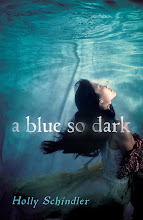
What I mean is, what comes easiest for me as an author is the internal dialogue and metaphorical, poetic writing that filled much of my debut, A BLUE SO DARK…In fact, when PLAYING HURT was in development, my editor sent me a copy of the manuscript with all the metaphors highlighted, telling me I HAD to prune some of it back!
What’s tough is to write something physical as it’s happening—and make the scene feel real. I so admire authors of genre fiction—mystery, adventure, horror—who can write dramatic scenes that you can see, hear, smell, feel.
…That’s what I’d love to do more of, as an author: dramatic, physical writing.
How’s your softball season been this year?
C: Sadly my school season has ended. We had our last game this week. The seasons go by so fast that I barely felt like we played all the games! It was a pretty good season, but now I can concentrate on my travel team I'm on for the summer. I play for a 16U tournament team that goes through the end of July. It really a wonderful thing to be a part of if you're really into the sport. I know I have a great time with my teammates over the summer playing in different places. I've also had a great time talking with you, Holly, about your book and softball. Thank so much for having me on my blog and thank you all for reading!
Thanks so much, Caitlin, for taking the time to talk about sports, and for your insights and love of literature…Best of luck this summer—and be safe on the field!
Imagine my thrill, then, when a ball player signed up for the PLAYING HURT Blog Tour! Yes—a book nut and an athlete, all rolled into one! I was absolutely delighted to get a chance to interact with Caitlin at Scarrlet Reader, to discuss PLAYING HURT and athletics in YA literature.

HS: Hi, Caitlin! Can you tell us a bit about yourself—and your sports history?
C: Hey Holly! Thanks so much for having me here. Now, a bit about myself? Well, I’m a 15 (almost 16!) year old sophomore in high school. I’m a very active and competitive person and I have a great love for reading. My sports history goes all the way back to when I was about 6 years old when I started playing soccer, but now a day, I’m a strictly softball only player. It really is a passion of mine. I’ve played from my town recreation team for seven years to a tournament 16U travel team. While reading Playing Hurt, I was wondering if it was a love of playing a sport that helped inspired the book.
HS: Oh, if you only knew…I’m really, really not an athlete. I’m a bit of a klutz, actually. (I swear I can fall around corners!) I’m really flattered, though, that the depiction of sports felt authentic enough to you that you wondered if I played / loved sports.
I definitely have a much stronger appreciation of athletics now that I’m older—I realize now just how mental sports are. I can’t imagine what it must be like trying to come back to the game after an injury—or even after surgery, as is often the case with athletes who have overused their bodies.
I believe you’ve had some experience with a sports-related injury yourself. Can you tell us about that?
C: Well, I’d first like to thank God that I have never had as severe injury like Chelsea (*knocks on wood*), but I have definitely had my fair share of sports injury in my years. One of my most serious injuries from over the years happened when I was pitching for softball. It was just a regular game while I was pitching. A girl comes up to hit, I pitched the ball, and it all happened really fast. The ball had hit off the bat and came straight back at me, towards my face. I had enough reflexes to try and bring my mitt up to block the ball, but I was only able to reflect it a bit and it hit me on the side of my face right next to my left eye. I remember hearing the gasp from the people in the stands and the pain on the side of my face. I was kind of in shock and just fell to a knee. My coach ran out and they took me off the field. I was examined and ice packed. I honestly just like to shake these kinds of things off but people love to make a bigger situation out of things then needed and they didn’t let me play for the rest of the game. I ended up coming out of it with minor scars, but I did have a giant, nasty purple bruise on my face for two week (not fun, lots of cover up).
It just shows how easily you can be hurt and how suddenly. I’ve had teammates with broken legs, strained wrist and angles, and even a few knocked out teeth and, it’s scary thinking about all the possibilities of injuries that could happen. I’ve been hit by pitches (once really bad in the head, but thank Lord for helmets), ground balls, aching shoulders from pitching too much. I’m use to those pains, but a permanent pain like with Chelsea’s hip is something that I’m not sure I could deal with. Which leads me into asking – Why was it a hip injury you chose to have happen to Chelsea? I know with basketball players sprained ankles or wrist would be pretty severe too, so a hip injury was something I wasn’t expecting.
HS: First of all, I’m so sorry to hear of your accident. Though I’m a bit of a klutz, I’ve never broken a bone…I can’t imagine how much your injury must have hurt…
When I came up with the sports subplot (which didn’t come about until the very last rewrite…about five years after I wrote the first draft!), I immediately imagined Chelsea as a workaholic. Somebody who lived basketball—who felt guilty when she wasn’t working out, or practicing, or engaged in visualization techniques…
I also knew I wanted to show the scene of Chelsea’s accident, and wanted a dramatic impact—I tried to picture scenarios of Chelsea falling, and what it might look like from the stands—or from the screen of Chelsea’s bedroom TV, as she watched the DVD of her last game over and over…
Of all the scenarios I imagined, none seemed quite as dramatic as Chelsea coming down from a jump, into the splits—and breaking her already-stress-fractured hip.
What kind of impact has being injured had on your ability to play? Do you find yourself hesitant now in a way you weren’t before? What’s the mental healing process been like?
C: Well, being physically hurt, believe it or not, causes me more mental pain then being in actual physical pain sometimes. There have been times where my shoulders are killing me or my elbow feels like it’s got to burst, but I never like to let it on so it’s always a mental battle with myself to push past the annoying pains. There have been times where injuries have affected my playing, like when I sometimes twist my ankle the wrong way and can’t run as fast as I want or my shoulder starts to hurt and I can’t pitch as consistently, but I would say I have never been hesitant towards going right back into it (unless for some reason I’m really nervous about playing a certain team!)
Though, it was actually just a few days away during my softball practice that I was hitting off the machine when one of the balls I hit spun weird and hit me in my leg. It stung real bad so I had to sit down, and as I was doing so I was thinking about how funny it was that I was talking to you about the injuries I’ve gotten from sports and how often they happen. Though, I have to say that I haven’t really experienced any emotional injuries relating to sports like Clint or Chelsea did.
So, I was wondering if you thought that emotional injuries (like with Clint’s past and Chelsea’s loss of basketball) have a stronger impact then physical injuries?
HS: I think the mind is the toughest “muscle” to heal. Once you know the pain of an injury—emotional or physical—it’s got to be really hard to put yourself in line to be hurt again. I really admire athletes who get back in the game after an injury.
I do understand why athletes would want to get back out there, though…In order to write Chelsea, I just imagined that she felt the same way about sports that I felt about my writing. If something happened to me that made it impossible for me to continue writing, I’d be devastated. My sense of self would be shattered. It’d change my life completely.
What are your thoughts on sports in literature? Do you find, as an athlete, that they’re presented accurately? Do you see holes that you’d like filled—even holes you hope to fill yourself (if you have any interests in pursuing writing)?
C: I must say that if an author uses sports in literature well, it can really capture reader’s attention, especially younger readers and boys. Sports are a huge part of the world today and if used correctly it can broaden your reader audience.
Though I must say that there are sometimes I’ll read a book and the author will use a sport in a negative way and it will really get on my nerves. Let’s just take the universally unrated sport, cheerleading. I’ve read dozens of books where the cheerleaders are the stupid, clueless girls who don’t know how to add or the super bitchy girls that are weak sluts. Whoa, hold on a minute, have you ever even tried to cheerlead? Do you know how much upper and lower body strength you need? How much hand-eye coordination you have to have? And let’s not get into how flexible you need to be. Just think about it. If an author writes for young adults you are writing for teenagers who do these sports you are insulting. You are possibly losing an entire category of readers by insulting one’s sport. I know I would not feel friendly towards a book that insulted softball.
Getting off my rant, there are really great books that accurately represent sports (Staying Fat for Sarah Byrnes and Deadline by Chris Crutcher, Oh. My. Gods. by Tera Lynn Childs, and, of course, Playing Hurt by Holly Schindler). All these books bring feeling into the sports they talk about and I feel like any sports lover would enjoy then. As for holes I see in the writing of sports, I’m really no expert on all sports I read about (except for maybe softball ^^). I’m not sure that if I did pursue writing that I would write about sports. Softball is something that I do out of enjoyment and for myself. If I ever were to pursue writing, it’d probably be fantasy and I’d invent my own sport, haha.
I loved talking about my love of sports with you Holly and just from reading Playing Hurt I could tell you took great care into reading about Chelsea and Clint’s sport history. You think you’ll write a book with sports in it again?
HS: I love what you just said about cheerleading. That’s so incredibly spot-on—both about the amount of strength and focus it takes in order to cheerlead, and about the way a negative depiction can limit an author’s readership…Very intuitive…
As for my own writing, I’d love, love love to write more physically-oriented books. Not necessarily just about sports, either…
What I mean is, what comes easiest for me as an author is the internal dialogue and metaphorical, poetic writing that filled much of my debut, A BLUE SO DARK…In fact, when PLAYING HURT was in development, my editor sent me a copy of the manuscript with all the metaphors highlighted, telling me I HAD to prune some of it back!
What’s tough is to write something physical as it’s happening—and make the scene feel real. I so admire authors of genre fiction—mystery, adventure, horror—who can write dramatic scenes that you can see, hear, smell, feel.
…That’s what I’d love to do more of, as an author: dramatic, physical writing.
How’s your softball season been this year?
C: Sadly my school season has ended. We had our last game this week. The seasons go by so fast that I barely felt like we played all the games! It was a pretty good season, but now I can concentrate on my travel team I'm on for the summer. I play for a 16U tournament team that goes through the end of July. It really a wonderful thing to be a part of if you're really into the sport. I know I have a great time with my teammates over the summer playing in different places. I've also had a great time talking with you, Holly, about your book and softball. Thank so much for having me on my blog and thank you all for reading!
Thanks so much, Caitlin, for taking the time to talk about sports, and for your insights and love of literature…Best of luck this summer—and be safe on the field!
Friday, February 25, 2011
SARAH OCKLER: COOLEST, THICKEST-SKINNED AUTHOR (AND PLAYING HURT LOCALS #5)

 We all say it, as authors. Jokingly, of course: how we’d love to get a book banned. Under the header of “No Publicity is Bad Publicity,” we talk about how our sales would spike. We’d get to be notorious (which is every bit as good, if not better, than just plain famous).
Until, of course, it actually happens. Or—someone attempts to make it happen. As Sarah Ockler knows.
Yes, oh, yes, those of you in the Missouri area know I’m talking about the great Scroggins debacle. The attempt of one narrow-minded individual to ban the books of two incredible YA authors (Laurie Halse Anderson, whom I greatly admire, was also in his quest to ban).
No author can stand idly by, quietly, and just be glad they missed the bullet when the subject of banning rears its head. Because the bare truth is, we could all be banned. Every single one of us with a book in print. If you can type it, it can be twisted, taken out of context, misinterpreted and misrepresented.
I love and admire Sarah for exhibiting such grace during such a difficult time. To show our continued support, we ought to all order a copy of TWENTY BOY SUMMER and FIXING DELILAH now—even if we already own a copy. Buy one for a girl you love. Introduce her to a woman to admire.
…I’m thrilled to wrap up my Local Leg of the PLAYING HURT Blog Tour at Sarah’s blog. (You can get over to Sarah's blog, leave a comment, post links, and officially start filling out the contest entry form for the PLAYING HURT signed-copy contest)...I stand with the vast majority of my fellow Missourians when I say I do not support book banning, as I relate in the post which also appears today on Sarah’s blog:

Barefoot in the Bible Belt
Wull, gaaaw-lee, shore is a might cold ‘round these here parts. It’s Feb’rary, after all. Where’m I gon’ get a little heat? Think I’ll jes’ burn these here books. Ain’t nothin’ but a bunch ‘a smut in ‘em, anyhowse.
Come on—that’s the picture you get, isn’t it? All I have to say is “Midwest” or “Ozarks,” and you get that image: a barefoot hillbilly who’s never used a be-verb correctly in his entire life.
And as soon as I think of that stereotype, I get a full-body cringe.
I’m a lifer myself—born and raised in Springfield, Missouri. And when the Scroggins debacle ensued in the fall of 2010, and the works of Sarah Ockler and Laurie Halse Anderson were unfairly targeted in one man’s narrow-minded banning attempt, all I could think was, “Here we go again.”
But I’m not talking about banning—not entirely. I’m also talking about that ridiculous, awful, barefoot hillbilly stereotype. Because in addition to attacking the work of two incredible young adult authors, I feared Scroggins’s complaint was also about to add to the unfair stereotyping of Missouri.
In the months since the story broke, the headline continues to pop up here and there in the blogosphere. And just as I feared, instead of identifying Scroggins as the source of the banning attempt…Yep, you guessed it—the headlines or quotes or discussions that pop up indicate MISSOURI wants to ban books. MISSOURI stands for censorship.
Actually, the majority of us don’t.
I could go blue in the face pointing to a myriad of dry facts proving my point. I could talk about the slew of local bloggers who put up posts expressing disdain for Scroggins’ attempt. I could talk about the fact that MSU students convened to protest book banning.
…But more important than these overt, published examples of fellow Ozarkers’ disgust over book banning is that which can’t be quoted or measured or recorded. It’s the open-mindedness that has lived in the blood of so many Ozarkers for generations. A traits that stands in direct opposition to the goals of Wesley Scroggins.
Just as much as I feel the work of my fellow YA authors was completely miscategorized, I also feel that much of my own Missouri’s opinions have been unfairly categorized. And just as an author’s work can’t be judged by lifting a stray line out of context, neither should an entire region be judged by one man—or even one school district—that attempts to pull a book from library shelves.
To me, Missouri has always been a place of strength—and, yes, of open-mindedness. A place that I’m proud to call my home—and to showcase in my writing…
Monday, March 8, 2010
YA ON YA
 Ever wonder what thoughtful teen readers really think about what’s being published in YA? I recently had a chance to chat with Sam, a local reader, writer, and blogger, about the genre.
* To start us off, could you tell us a little about yourself?
When I was eight, I wrote a story for Halloween. In it, the rivers turned to blood and eyeballs grew on trees. Instead of sending me to the school counselor, as maybe she should have, my teacher laughed. She thought it was awesome. I have a particularly clear image of her in that moment; she held up the story to the class, pointed at me with one hand and said, “Someday, she’s going to be an author.”
Yeah, well, not quite.
I’m fifteen, though, so I guess that’s okay. I’ve been writing stories since that day in third grade. Only recently have I actually started to write anything worth reading. I’ve sent a few queries out and have gotten partials/full requests. Part of my story is on a website called inkpop.com—it’s ranked number in the top five right now, which means Harper Collins will review it at the end of the month. [Sam’s submission can be found here.] For now, though, my life revolves around school and my friends. Oh, and books. Lots and lots of books.
* As an author whose first book will hit store shelves in May, I’m dying to know—how do you choose the books you read? Recommendations from friends? Blog reviews? Covers / titles? Publishing house?
It depends. If I'm online, then it's usually through blogs. I see a book, or an author, and go look it up on Amazon. If I like it, I go and hound my mom to buy it. I like that method more on some level because I usually know what I'm getting into.
If I'm in a store, I kind of fall into that horrible 'judging-book-by-cover' category. Right now, there are so many books in YA. It's an overload of pretty and awesome books, but the cover and the title will actually get me to pick them up.
Friend recommendations actually play the biggest role, though. I mean, I find more on my own, but if someone tells me how much they liked a book, I'm more likely to read it quickly. My mom and I trade books a lot of the time, too—if she tells me to read something, then I'll almost always.
* What KEEPS you reading—what grips you, keeps you turning the pages?
Hah, that's kind of hard to answer! I think it's emotion. If I care about the character, I'll keep reading. It doesn't even really matter whether I like or dislike them—I've just got to feel something. For instance, in Gone With The Wind, the main character really annoyed me. However, I could empathize with her, and in a sick way, I kind of admired her. I cared about what happened to her. The books I put down are the ones that have flat characters.
Oh, and humor helps too. :D If I can laugh at a book, I will keep reading. It doesn't matter how twisted or dark the story is, if there is some sort of weirdness to laugh at, the pages will keep turning.
Oh, and humor helps too. :D If I can laugh at a book, I will keep reading. It doesn't matter how twisted or dark the story is, if there is some sort of weirdness to laugh at, the pages will keep turning.
* How do feel about reading books that contain characters who are younger than you?
I'm getting better about that as I get older, but it kind of bothers me sometimes. Of course, I'm fifteen, so that rarely happens in YA—it's usually the middle grade novels, and I try to keep away from middle grade in general. Still, though, if the book is good enough, it doesn't matter. Just look at Harry Potter. I grew up with the books—I was in the first grade when I read Sorcerer's Stone—but I can still reread them and not be bothered.
* Do you enjoy reading books about or from the perspective of the opposite sex (a male narrator)? How about a narrator of a different race / cultural background? Do you feel that YA stacks the deck with white females?
Yeah, I think YA does seem to be filled with white girls. It isn’t overloaded, though; I can think of several that are multi racial or from guys point of view that have done pretty well. I actually like reading those more sometimes, just because there are less of them. I mean, teenage girls with a love for a sexy, smoldering vampire tend to blur together. A guy is rare in YA books, so I can actually probably name more; same with other cultures.
Guy point of view in particular is kind of enjoyable to read. The Percy Jackson books, for instance, by Rick Riordan, are awesome. As for books with different races or backgrounds, well, those tend to be pretty interesting. If I can actually learn something when I’m reading, then I like the book more.
* What do YOU write—and how does that influence what you choose to read?
Hah, I feel pretentious talking about my stories, mostly because what I write is just random. I mean, the ‘novel’ (I hate calling it that; it sounds like I’m trying to make something out of it that it isn’t) that I’ve actually shown people and even sent to several agents is a dystopian novel. However, I’ve got another about demons and another that is realistic fiction. I write whatever pops into my head, and I kind of read the same way. Some of my favorite books are about dystopian societies (Hunger Games by Suzanne Collins, for example) and some are about vampires, as much as it kind of hurts to admit (Richelle Mead’s Vampire Academy comes to mind.)
It influences it on a very base level, though, because I read books and think 'Well, good. I guess I'm on the right track.' However, I read so much that usually I just stumble across books. If they correspond to what I'm writing, awesome, but I don't really require it.
* How does blogging influence what you choose to read?
A ton. There are a couple of author’s blogs that I religiously check out, and I’m on Amazon a lot.
If Meg Cabot recommends a book, I will check it out. If Maureen Johnson rambles about a story, I’ll go and look it up. It’s like I said; I take recommendations pretty seriously. From published authors, though, I know it has to be good because they’re tacking their names onto someone else’s work. If that work is bad, then they look bad.
As for my own blogging, well, that really isn’t affected. I only talk about books I really like; I don’t see the point in giving mean reviews. I read a ton, though, so that really isn’t an issue. Chances are I will find a book I love in under a week, just because I do read so much. Reading is kind of my hobby; while some kids spend their internet time on Facebook, or their free time watching tv, I’m either with a book or on the internet looking them up.
* How does your interaction with an author change how you feel about what they write?
I’ll love it twelve zillion times more. :D
I know it probably shouldn’t, but it really will change my opinion. I mean, come on; I’m fifteen. How many adults would give me the time of day regardless? (The answer is ‘not many’, by the way. No, I’m not griping; it’s just how it goes.) When an author takes the time to email me back, I think it shows that they really care about what they’re doing. Plus, when I read their books, I have the almost unholy satisfaction of 'Haha, I got to talk to the author.' For instance, Maggie Stiefvater did a video chat with a group of kids at my local library. Now, whenever I read her book, Shiver, I do a happy dance because I actually got to talk to the author, and I know what was going through her head when she was writing.
* What have you read that made you roll your eyes and say, "That's SO not the way it is now"?
Bad dialogue. That’s the number one thing that will annoy me in a story. Kids don’t talk that differently than adults. Kids who read really don’t talk that differently at all. I feel condescended too when the dialogue sounds like it came straight from a bad cliché. Yes, I use slang. Sure, when I text ‘OMG’ will occasionally pop up. The majority of the time, though, I tend to speak the same as most adults. Plus, slang changes too fast. I have never heard someone say ‘Man, that was a friggin’ dope party’ but I’ve read it dozens of times. That’s fine every once in a while, but sometimes it just feels as if the book is trying too hard to be cool.
* How relevant is your assigned classroom reading? Does it bore you? Excite you? Do you wish contemporary writing could be more like the classics? In what way?
I’m probably a bad kid to ask about this, because I love reading, and I love my English class. I trust my teacher to have good taste in books; I take Honors, so it’s especially nice. I have liked every book I’ve read this year in my English class. We read A Separate Peace by John Knowles, and I liked it enough to have my mom go buy it. It’s beautiful written. We just finished Animal Farm by George Orwell. I’ve never had a book inspire so much annoyance in me; no, not because I didn’t like it, but because the societal parallels are astounding. For our independent book project, I read A Long Way Gone; Memoirs of a Boy Soldier by Ishmael Beah. It was gruesome and gritty, and I enjoyed it immensely. I don’t like nonfiction, but that’s one particular story that really affected me.
I don’t wish contemporary was more like the classics, though. I think the classics are remarkably similar to today’s writing; they go after the same issues in many ways but the writing is just vastly different. I think that’s cool. I can learn about a time period just by the way the author wrote. I like classic novels and novels that come out today, but I wouldn’t wish either to change.
* What role does technology play in your life and reading? Do you cringe when you read a slightly older book that has out-of-date technology?
Nope! There is no cringing. Actually, it doesn’t affect my reading at all. Again, I think it’s cool. Look at Ender’s Game by Orson Scott Card. He’s got a ton of technology in there that he made up; it isn’t the same today, but it’s still cool to read about. And as for out-of-date novels, they don’t bug me. However, I do tend to read more fantasy than anything, and those will always be in style.
As for how it affects my life, that’s different. I don’t think there’s a part of my life that isn’t touched by technology. My cell phone is always in my pocket, I spend more time texting than talking on the phone, and I actually don’t think I’ve ever written a letter by hand. (Well, I did in Elementary school for an assignment, but I don’t think that counts.) I’ve been typing since I was eight—in eighth grade, I averaged roughly 115 words a minute—and my camera lives in my purse. It affects how I write, I think, even if it doesn’t affect how I read; I mean, it would be hard for me to write a story without technology in it, just because it is such a huge part of my life.
* What do you think YA writers, as a whole, do well?
Oh, goodness. What don’t they do well? Hmm. They keep us teenagers entertained. They have good characters. I’ve never really read an adult book that makes me care as much about the characters as I have in YA. (I’m biased, though; I’m fifteen, so I’m bound to like my own age better.) Still, overall, the characters in YA books are awesome. I mean, come on—Edward never would have been so famous if people didn’t care about him. I never would have consented to putting a Hunger Games pin on my backpack if I didn’t love Katniss and Peeta so much. YA writers rock at making us care/love their characters.
* In what ways do you think YA writers miss the mark?
Okay, I’ve got one. It’s the curse of trilogies. So many YA books come in sets of three. Now, that’s awesome. I mean, seriously, I get three books to read about my favorite characters instead of one. However. I think YA writers are bad sometimes about making each book stand by itself. Instead, it’s just like three parts to one giant novel. That can be kind of annoying. Every story needs a start, middle, and end, even if it will eventually plug into a bigger picture. YA authors seem to be particularly bad about this.
* Finish the following sentence: "More than anything, I wish that YA authors would___"
Do signings close to my town.
-sigh- If only.
...You can always catch up with Sam by checking in at her own blog: One Sparkling Star.
In the meantime, thanks, Sam, for your insight!
Subscribe to:
Posts (Atom)