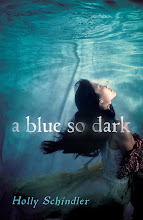
And…I’m thrilled to announce I’ll be at the Borders on Glenstone in Springfield, Missouri to sign copies of A BLUE SO DARK! June 26, 1-3 p.m.
See you there!


 Ever wonder what thoughtful teen readers really think about what’s being published in YA? I recently had a chance to chat with Sam, a local reader, writer, and blogger, about the genre.
Yeah, I think YA does seem to be filled with white girls. It isn’t overloaded, though; I can think of several that are multi racial or from guys point of view that have done pretty well. I actually like reading those more sometimes, just because there are less of them. I mean, teenage girls with a love for a sexy, smoldering vampire tend to blur together. A guy is rare in YA books, so I can actually probably name more; same with other cultures.
Guy point of view in particular is kind of enjoyable to read. The Percy Jackson books, for instance, by Rick Riordan, are awesome. As for books with different races or backgrounds, well, those tend to be pretty interesting. If I can actually learn something when I’m reading, then I like the book more.
* What do YOU write—and how does that influence what you choose to read?
Hah, I feel pretentious talking about my stories, mostly because what I write is just random. I mean, the ‘novel’ (I hate calling it that; it sounds like I’m trying to make something out of it that it isn’t) that I’ve actually shown people and even sent to several agents is a dystopian novel. However, I’ve got another about demons and another that is realistic fiction. I write whatever pops into my head, and I kind of read the same way. Some of my favorite books are about dystopian societies (Hunger Games by Suzanne Collins, for example) and some are about vampires, as much as it kind of hurts to admit (Richelle Mead’s Vampire Academy comes to mind.)
It influences it on a very base level, though, because I read books and think 'Well, good. I guess I'm on the right track.' However, I read so much that usually I just stumble across books. If they correspond to what I'm writing, awesome, but I don't really require it.
* How does blogging influence what you choose to read?
A ton. There are a couple of author’s blogs that I religiously check out, and I’m on Amazon a lot.
If Meg Cabot recommends a book, I will check it out. If Maureen Johnson rambles about a story, I’ll go and look it up. It’s like I said; I take recommendations pretty seriously. From published authors, though, I know it has to be good because they’re tacking their names onto someone else’s work. If that work is bad, then they look bad.
As for my own blogging, well, that really isn’t affected. I only talk about books I really like; I don’t see the point in giving mean reviews. I read a ton, though, so that really isn’t an issue. Chances are I will find a book I love in under a week, just because I do read so much. Reading is kind of my hobby; while some kids spend their internet time on Facebook, or their free time watching tv, I’m either with a book or on the internet looking them up.
* How does your interaction with an author change how you feel about what they write?
I’ll love it twelve zillion times more. :D
I know it probably shouldn’t, but it really will change my opinion. I mean, come on; I’m fifteen. How many adults would give me the time of day regardless? (The answer is ‘not many’, by the way. No, I’m not griping; it’s just how it goes.) When an author takes the time to email me back, I think it shows that they really care about what they’re doing. Plus, when I read their books, I have the almost unholy satisfaction of 'Haha, I got to talk to the author.' For instance, Maggie Stiefvater did a video chat with a group of kids at my local library. Now, whenever I read her book, Shiver, I do a happy dance because I actually got to talk to the author, and I know what was going through her head when she was writing.
* What have you read that made you roll your eyes and say, "That's SO not the way it is now"?
Bad dialogue. That’s the number one thing that will annoy me in a story. Kids don’t talk that differently than adults. Kids who read really don’t talk that differently at all. I feel condescended too when the dialogue sounds like it came straight from a bad cliché. Yes, I use slang. Sure, when I text ‘OMG’ will occasionally pop up. The majority of the time, though, I tend to speak the same as most adults. Plus, slang changes too fast. I have never heard someone say ‘Man, that was a friggin’ dope party’ but I’ve read it dozens of times. That’s fine every once in a while, but sometimes it just feels as if the book is trying too hard to be cool.
* How relevant is your assigned classroom reading? Does it bore you? Excite you? Do you wish contemporary writing could be more like the classics? In what way?
I’m probably a bad kid to ask about this, because I love reading, and I love my English class. I trust my teacher to have good taste in books; I take Honors, so it’s especially nice. I have liked every book I’ve read this year in my English class. We read A Separate Peace by John Knowles, and I liked it enough to have my mom go buy it. It’s beautiful written. We just finished Animal Farm by George Orwell. I’ve never had a book inspire so much annoyance in me; no, not because I didn’t like it, but because the societal parallels are astounding. For our independent book project, I read A Long Way Gone; Memoirs of a Boy Soldier by Ishmael Beah. It was gruesome and gritty, and I enjoyed it immensely. I don’t like nonfiction, but that’s one particular story that really affected me.
I don’t wish contemporary was more like the classics, though. I think the classics are remarkably similar to today’s writing; they go after the same issues in many ways but the writing is just vastly different. I think that’s cool. I can learn about a time period just by the way the author wrote. I like classic novels and novels that come out today, but I wouldn’t wish either to change.
* What role does technology play in your life and reading? Do you cringe when you read a slightly older book that has out-of-date technology?
Nope! There is no cringing. Actually, it doesn’t affect my reading at all. Again, I think it’s cool. Look at Ender’s Game by Orson Scott Card. He’s got a ton of technology in there that he made up; it isn’t the same today, but it’s still cool to read about. And as for out-of-date novels, they don’t bug me. However, I do tend to read more fantasy than anything, and those will always be in style.
As for how it affects my life, that’s different. I don’t think there’s a part of my life that isn’t touched by technology. My cell phone is always in my pocket, I spend more time texting than talking on the phone, and I actually don’t think I’ve ever written a letter by hand. (Well, I did in Elementary school for an assignment, but I don’t think that counts.) I’ve been typing since I was eight—in eighth grade, I averaged roughly 115 words a minute—and my camera lives in my purse. It affects how I write, I think, even if it doesn’t affect how I read; I mean, it would be hard for me to write a story without technology in it, just because it is such a huge part of my life.
* What do you think YA writers, as a whole, do well?
Oh, goodness. What don’t they do well? Hmm. They keep us teenagers entertained. They have good characters. I’ve never really read an adult book that makes me care as much about the characters as I have in YA. (I’m biased, though; I’m fifteen, so I’m bound to like my own age better.) Still, overall, the characters in YA books are awesome. I mean, come on—Edward never would have been so famous if people didn’t care about him. I never would have consented to putting a Hunger Games pin on my backpack if I didn’t love Katniss and Peeta so much. YA writers rock at making us care/love their characters.
* In what ways do you think YA writers miss the mark?
Do signings close to my town.
-sigh- If only.
...You can always catch up with Sam by checking in at her own blog: One Sparkling Star.
In the meantime, thanks, Sam, for your insight!